
By Dr. Kenneth Neufeld

The tear ducts in your eyes are responsible for draining the tears into the back of the nose. When the tear ducts are blocked, the tears can’t drain properly and will often spill out of the eyes and down the cheeks, as if the person were crying. Let’s explore some questions and answers around what a blocked tear duct is, the signs and symptoms, and how the condition is treated.
The symptoms of a blocked tear duct may not be readily apparent. In infants, blocked tear ducts may not be noticeable until the baby is one to two months old. At that time, the parents may notice that the child’s cheeks are wet, but they haven’t been crying, or that the baby’s eyes may appear very watery. In some instances, eye discharge may be noticed or the eyelids may appear crusty.
It’s important to note that blocked tear ducts are extremely common in babies, with nearly half of all infants experiencing the condition. However, only about 6 percent of all infants with blocked tear ducts will need intervention to correct the issue, according to the National Library of Medicine.
In adults, the blocked tear duct incidence rate is purported to be around 30 per 100,000 people, according to PubMed. When an adult has a blocked tear duct, they may notice excessive eye watering, recurring eye infections, and swelling or pain in the upper or lower eyelids. In some cases, the individual may notice redness in the white part of the eye (sclera). In adults, a blocked tear duct usually occurs on one side only. It can happen on both sides simultaneously, but this is less common.
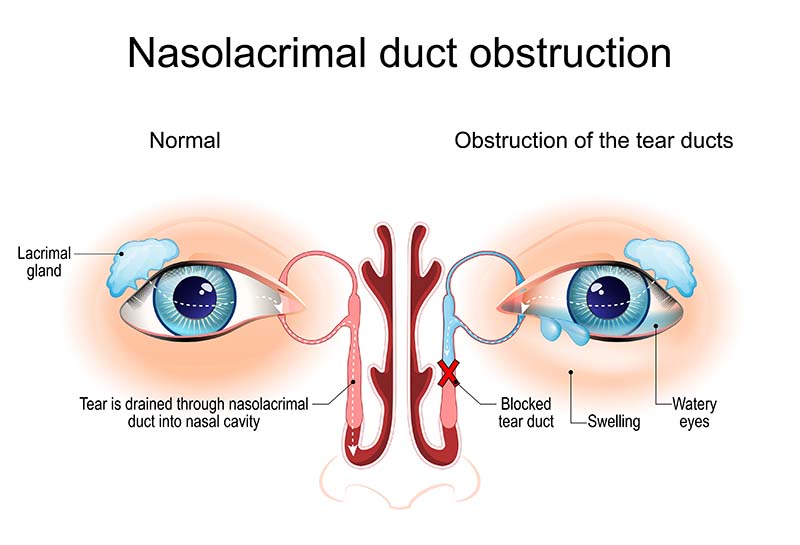
Infants are often born with the condition. In babies, blocked tear ducts happen because they’re not yet fully developed, or there’s a membrane over their Valve of Hasner, which is at the bottom of the nasolacrimal duct. For most infants, the causes of their blocked tear ducts resolve by the time they reach six to 10 months of age.
Adults can have blocked tear ducts for a variety of reasons. They may have a duct blockage that has persisted through childhood and into adulthood. The blocked duct could be due to a narrowing of the tear duct which can happen with age. The blocked duct could also be due to inflammation around the eyes and nose, swelling or sinusitis. It could be the result of an eye injury or age-related changes, or there could be a tumor in the nose or tear duct system that is narrowing the passageway or blocking the drainage outlet. The most common cause is an eye infection that finds its way down into the tear duct and causes a blockage.
Treating a blocked tear duct at home is possible. Here are some treatments you can try.
Blocked tear ducts in adults and children are treated slightly differently. Children are typically treated with probing and irrigation, Monoka® Stents or the Lacricath® balloon dilation procedure. Adults are typically treated with probing and irrigation or dacryocystorhinostomy (DCR).
Probing and irrigation surgery is often chosen because it’s minimally invasive and has a success rate of more than 90%. The procedure involves putting a thin probe into the puncta, which is the opening on the edge of the eyelid, near the nose. Then, the probe is guided down into the back of the nose. The probing may clear the blocked duct. Once the probing part of the surgery is complete, the duct will be irrigated to ensure it is functioning properly.
When the probing and irrigation surgery doesn’t result in the desired outcome, Monoka® stents can also be used in young children. The insertion of the Monoka® stents are performed under general anesthesia at one of our surgery centers and takes about 30 minutes. After the procedure, the stents are usually left in place for about four months.
In adults, clearing a blockage in the tear duct is done by a surgery called dacryocystorhinostomy (DCR). A DCR is a surgery that creates a new drainage path for the eye’s tears. At Thomas Eye Group, the procedure is done from the inside of the nose. It involves creating a new wider opening for the tears to drain. A tiny tube is inserted into the new wider opening in order to ensure the new drainage pathway remains open. The tube or stent is left in for approximately 2 months. This procedure has a 90% success rate and takes 15 minutes to perform in our surgery center. Patients can resume their normal activities in 2 days.
Blocked tear ducts in babies, children, teenagers and adults can be treated. At Thomas Eye Group, we have doctors who can diagnose and treat any cause of tearing in any age patient. If you’re having trouble with a blocked tear duct, schedule an appointment at one of our Atlanta Eye Care Centers.
Kenneth R. Neufeld, M.D., is a Board Certified ophthalmologist and oculoplastic surgeon specializing in cosmetic and functional procedures of the eyelids, brows, and upper face. He earned his medical degree from the State University of New York at Syracuse, completed his ophthalmology residency at The New York Hospital-Cornell Medical Center, and completed a fellowship in oculoplastic, reconstructive, and laser surgery at Duke University Medical Center.
If you’re looking for a home remedy for a blocked tear duct, you’ll be pleased to know that there are a few. Blocked tear ducts can be treated with warm compresses, sinus irritation with a sterile saline solution and cleaning the eyes and eyelids to remove any dirt or debris. If these at-home treatments don’t provide relief, it’s best to schedule an appointment with one of our Atlanta ophthalmologists.
Blocked tear ducts in newborns usually resolve on their own by the time the child is 6 to 10 months old. If you’re concerned about your baby’s eye watering or his or her eyes appear irritated, it’s best to schedule an appointment with one of our pediatric ophthalmologists.
If there is an infection present, an eye doctor may prescribe antibiotic drops, but these only clear the infection. They do not open the tear duct.
If the probing and irrigation procedure doesn’t work, another procedure may be recommended, such as a Monoka® stent.
Blocked tear ducts in adults are treated by performing surgery called -dacryocystorhinostomy (DCR).